Sergio Luzzatto The First Fascist review, recensie en informatie boek en biografie over het sensationele leven en de duistere erfenis van de markies de Morès. Op 10 februari 2026 verschijnt bij Harvard University Press de biografie van Marquis de Morès, de Frans-Italiaanse markies die gezien wordt als de eerste fascist, geschreven door Sergio Luzzatto, hoogleraar Italiaanse geschiedenis aan de University of Connecticut. Er is geen Nederlandse vertaling van het boek verkrijgbaar.
Sergio Luzzatto The First Fascist review en recensie
- “The First Fascist tells the fascinating story of a French aristocrat who made common cause with the ‘little guy’ and championed the emergent national populism and rabid antisemitism of the late nineteenth century. Engagingly written and built on solid scholarship, Sergio Luzzatto’s book chronicles the quixotic life of the Marquis de Morès as a cattleman in the American West, would-be railroad magnate in Asia, traveler in North Africa, and bitter agitator on the streets of Paris.” (Edward Berenson, author of Europe in the Modern World)
- “Part adventurer, part entrepreneur, part ideologue, the Marquis de Morès is one of the nineteenth century’s most intriguing figures, with exploits that span three continents. And above all, as Sergio Luzzatto demonstrates in this superb biography, he is the forefather of extreme-right nationalist and antisemitic movements that remain all too familiar to this day. The First Fascist offers an indispensable, urgently relevant look at a toxic past that is also, alas, a tragic prologue.” (Caroline Weber, author of Proust’s Duchess)
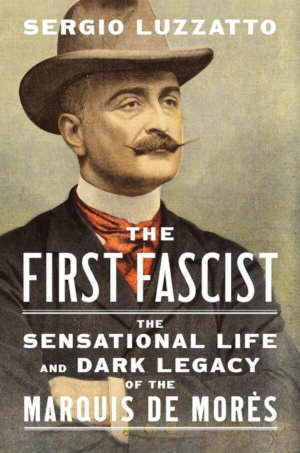
The First Fascist
The Sensational Life and Dark Legacy of the Marquis de Morès
- Auteur: Sergio Luzzatto (Italië)
- Soort boek: biografie, boek over fascisme
- Taal: Engels
- Uitgever: Harvard University Press
- Verschijnt: 10 februari 2026
- Omvang: 464 pagina’s
- Uitgave: gebonden boek / ebook
- Prijs:
- Boek bestellen bij: Amazon / Bol
Flaptekst van de biografie van markies de Morès, de eerste fascist
A vivid biography of the nineteenth-century French-Italian aristocrat Marquis de Morès, the first political leader to master the blend of racialized hatred, cross-class solidarity, and paramilitary violence that Benito Mussolini would call “fascism.”
The Marquis de Morès was the first populist, white supremacist, and openly antisemitic leader in the Western world. A key figure behind the Dreyfus affair, he took France by storm with his inflammatory rhetoric, media savvy, and violent stunts. Decades before Mussolini, Morès invoked the fasces—the ancient Roman bundle of wooden rods—to symbolize the society he wished to create: a union of all social classes against their enemy, the Jews.
Animated from his early years by personal ambition and the loss of aristocratic status in modern, democratic France, Morès embarked on an extraordinary career spanning four continents. He ventured to the American frontier and became a cattle rancher in the Dakotas; he set out to build a railway in the jungles of Indochina. But his efforts were dogged by failure—and he blamed Jewish machinations for his defeats. Embittered, he returned to France to pursue what he saw as the mission of an upper-class Frenchman: to fight Jews and other minorities on behalf of the white proletariat. Soon he controlled a large, violent militia of disgruntled workers.
As Sergio Luzzatto makes clear, Morès both anticipated and propelled the fascist politics that erupted in the twentieth century and still resonate powerfully in our own time. Morès’s rapid political rise was halted by financial scandal, but his shadow continued to loom. In Vichy France, as Jews were being deported to Auschwitz, officials would gather to celebrate Morès’s memory.
Sergio Luzzatto is Emiliana Pasca Noether Chair in Modern Italian History at the University of Connecticut. A winner of the Cundill History Prize, he is the author of The Body of Il Duce and Primo Levi’s Resistance, among other books.

