
Tiffany M. Hale Fugitive Religion review and information book about the Ghost Dance and Indigenous Resistance After the U.S. Civil War. Yale University Press will publish the book by Tiffany M. Hale, professor in the Department of Religion at Barnard College of Columbia University, June 16, 2026. Here you can read information about the content of the book, the author and the publication.
Tiffany M. Hale Fugitive Religion reviews and information
Whenever a review of Fugitive Religion, The Ghost Dance and Indigenous Resistance After the U.S. Civil War, written by Tiffany M. Hale, appears in the media, we’ll highlight it on this page.
- “In this rigorous, well-researched book, Tiffany M. Hale reintroduces the reader to the postbellum Indigenous practice of the Ghost Dance. By underscoring how this fugitive religious movement shaped a kind of racial consciousness among Indigenous communities in response to settler violence, Hale connects the Ghost Dance to the blues impulse within African American culture.” (Joseph Winters, Rutgers University)
- “Placing Black and Native ways of knowing in a revelatory dialogue, Fugitive Religion reimagines the nineteenth century as an entangled and prophetic world, a reservoir of spiritual possibilities easily misread or ignored. Tiffany Hale reveals a series of Ghost Dances, distinct in location and practice but kin in impetus and import, and so transports readers from the painful terrain of Wounded Knee to a history longer, wider, and deeper.” (Philip J. Deloria, Harvard University)
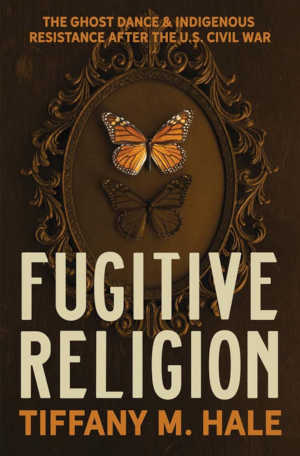

Fugitive Religion
The Ghost Dance and Indigenous Resistance After the U.S. Civil War
- Author: Tiffany M. Hale (United States)
- Book type: history of the city of Shanghai
- Publisher: Yale University Press
- Series: The Henry Roe Cloud Series on American Indians and Modernity
- To be released: June 16, 2026
- Length: 296 pages (15 color illustrations)
- Size: 15,5 x 23,5 cm
- Format: hardcover / ebook
- Prize: $ 45.00
- Buying options >
Blurb of the book by Tiffany M. Hale on the Ghost Dance and Indigenous Resistance
A bird’s-eye look at the Ghost Dance, the first instance of modern, collective racial self-consciousness for Native peoples in the United States.
From the Sand Creek Massacre (1864) to the Massacre at Wounded Knee (1890), Indigenous religious practices—legally banned after 1883—took on new meanings as acts of defiance against colonialism and white supremacy. By reexamining the familiar story of the Ghost Dance and Wounded Knee Massacre and placing it into the context of resistance by Black and Native peoples during Reconstruction and Redemption, historian Tiffany M. Hale explains the Ghost Dance not just as a religious movement but also as a complex social phenomenon that enabled Indigenous people to maintain their identities and communities despite the pervasive force of colonialism and the challenges of modernity.
Chronicling how individual Native people, their families, and communities navigated the fraught post–Civil War conditions of the United States, Hale suggests that Ghost Dances hold something in common with blues traditions of working-class African Americans. By giving Ghost Dance participants a chance to reflect on their lived experiences of warfare, deracination, and diplomacy, “fugitive religion” helped create modern racial self-consciousness in the United States.
Tiffany M. Hale is assistant professor in the Department of Religion at Barnard College of Columbia University. She is a scholar of Indigenous religious traditions whose work focuses on nineteenth century Native American history and United States race relations. Professor Hale teaches courses in global Indigenous religious traditions, Native American history, and religion in the Americas.